The Ranks
Sandra Jõgeva, Kaarel Sammet
Sculptures, room installation
Draakon Gallery, Tallinn
2008
Press Release
Hierarchical ranks were abolished in Estonian Republic by the Constitution dating back to the year 1919. Rural code had alienated the land properties of the nobility and church.
However, still in the new Estonian Republic (since gaining the independence from the Soviet Union in 1991) we constantly hear about harsh differences in ranks typical to early capitalism, about class - or caste society.
The differences of ranks have arisen and arise not only within one particular nationality, but rather cover entire countries, nations or even continents. Latin-Americans and Eastern-Europeans who go to work at positions the rich Westerners consider not prestigious enough, tough and/or financially not sufficient, are taken as service providers-servants and are attributed with characteristics that have throughout centuries been typical to representatives of lower classes, such as ignorance, secrecy or laziness.
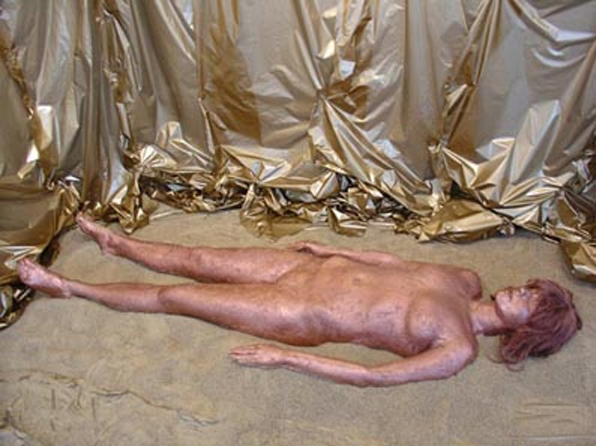
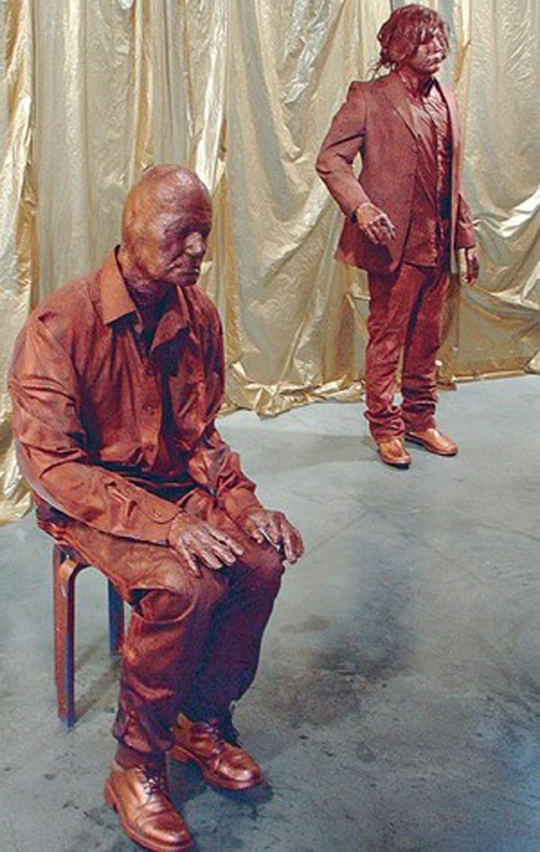
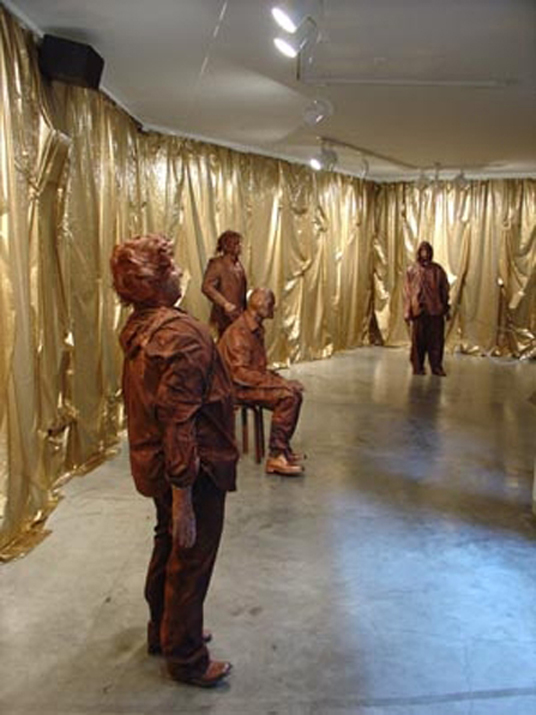
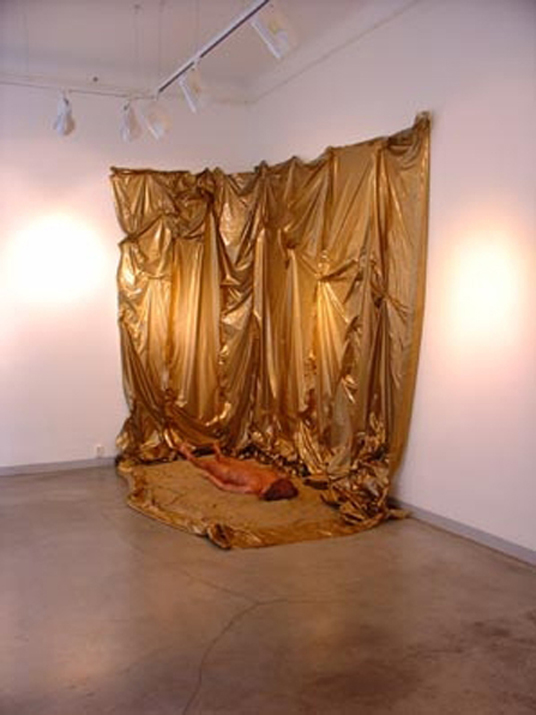
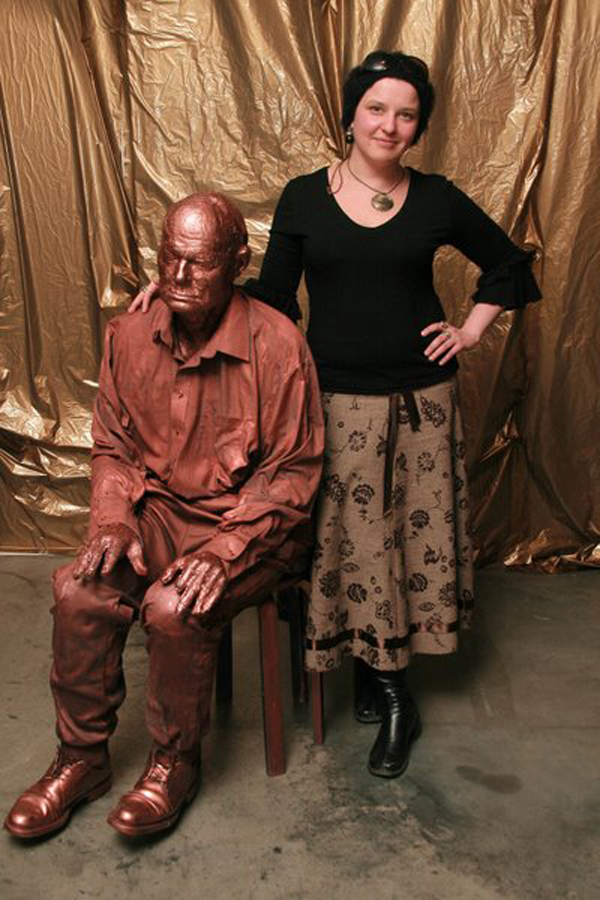
Ranksdepicts pseudo-monuments to some rather blur and hidden representatives of ranks that can be witnessed in the cities, towns and villages of today’s Estonia . If one looks at the passers by on the street (s)he immediately notices signs of belonging to a certain class, both hidden and consciously demonstrated.
By charting the types I accordingly find models who are either authentic representatives of the particular rank or from among models who respond to all the necessary criteria.
Gypsum impressions are taken from the people’s faces, bodies and hands that are cast into glass fiber and plastic resin moulds. The result resembles monuments similar to bronze monuments. They are wearing clothes typical to their rank; the clothes as well as the statues are entirely covered with bronze spray paint.
The exhibition Ranksis as if a monument to the phase in the development of Estonian society, to the transition period where many are trying to look better, wealthier and more successful than they in fact are, some have come to terms with the present situation and others have lost all hope to ever make their way back to the society. Models have been chosen to represent the age group and social layer they actually represent. They are the ones these pseudo-monuments are meant for.
Photo: Jaan Klõsheiko
| Press Release |
| Joint exhibition “Ranks” by Sandra Jõgeva and Kaarel Sammet at Hobusepea Gallery, 13.03.2008–24.03.2008 On Wednesday, 12.03.2008 at 17:00, the joint exhibition “Ranks” by Sandra Jõgeva (b. 1976) and Kaarel Sammet (b. 1976) opens at Hobusepea Gallery. As the artists write in the exhibition’s accompanying text, the exhibition presents a kind of pseudo-monument to today’s Estonia’s blurred and hidden ranks, whose representatives one meets every day in cities, towns and villages. Watching passers-by on the street for a while, one can notice signs of class affiliation, both hidden and consciously displayed. Ranks were already abolished in the Republic of Estonia by the 1920 Constitution; the 1919 Land Act had expropriated the large landholdings of the nobility and the church. Yet in the new Republic of Estonia there is constant talk of the sharp, early-capitalist-style differences between ranks, of a class and caste society. Whereas a caste society is by its nature an ontocracy — one is born into a caste, it is unavoidable — a society of ranks is a meritocracy, based on merit. Moving between ranks is difficult, but possible. In the modern class society, however, the difference between classes is one of wealth — you either have it or you don’t, in the broadest sense. Whether and how much people are aware of their class affiliation depends on the country and the society. Estonia is undoubtedly closer in spirit to Eastern Europe than to Western Europe; aside from the elite, there is little sign of class-consciousness here. “Prole” and “rabble” are words carrying a strong negative charge, the cult of success is unquestioned, and poverty is a disgrace. It is therefore hard to say, for instance, which class a poorly paid, rather poor schoolteacher belongs to — someone who elsewhere would unquestionably be a member of the middle class. Today the whole world is quietly moving away from the atomised model built on the ideal of liberty-equality-fraternity, in which society consists essentially of equal individuals, protected in their equality by the laws that govern them. Unfortunately, the sense of wholeness and the understanding of one’s place, duties and necessity that pre-democratic eras once offered have been lost. The spread of democracy brings with it ever greater individualism and the view that one’s fate is a private matter, whose connection to society as a whole organism is barely felt. Yet the free labour market — which drives migration and the rapid relocation of entire industries according to local wages — testifies to a movement toward a more organic model. The people who, because of this, often find themselves in a very difficult and complicated situation have nonetheless been taught from childhood that they are equal, unique individuals and that everything depends on themselves. The opening exhibition is a kind of monument to the current stage of development of Estonian society, to a transitional period in which many try to appear better, wealthier and more successful than they really are, some have made peace with the situation, and others have lost all hope of ever finding their way back into society. This press text was compiled using the project description by Sandra Jõgeva and Kaarel Sammet. The exhibition remains open until 24.03.2008. The exhibition is supported by the Estonian Cultural Endowment and Norfolier AS. Exhibitions at Hobusepea Gallery are supported by the Estonian Ministry of Culture. Many thanks to: Eike Eplik, Berit Talpsepp, Hannes Starkopf, Ain Nurmela, Triinu Jürves, Marje Mee, Rene Reinumäe, Maigi Magnus, Allan Tõnissoo, Villu Jõgeva, Ants Torim. Models: Malle Jürves, Okym Reem, Jaan Klõsheiko, Jekaterina Novosjolova, Kuldar Ebruk. Hair: Anu Aaremäe. Music: Andrus Elbing, Okym Reem. |